How to scale a web design business comes down to four things: a steady flow of leads, a sales process that doesn't depend on you being available, recurring revenue, and systems that let other people do work you used to do yourself. Most designers stay stuck because they only work on the first project in front of them and start marketing from zero when it ends.
This guide gives you 7 steps to fix that — with scripts, checklists and templates you can copy today. It's written for freelancers and small agencies selling websites to local businesses.
Step 1: Pick one niche and one city to dominate
Scaling starts with focus. When you sell to everyone, every pitch, portfolio piece and email has to be written from scratch. When you serve one niche — dentists, roofers, gyms, restaurants — you reuse everything: the same proposal, the same templates, the same objections handled the same way.
Choose a niche with money to spend and websites that are visibly bad. Then pick one city and commit to owning it before expanding. Not sure where to start? Browse these web design niche ideas and pick one where you already know someone or understand the industry.
- Businesses that make money per customer (dentists, lawyers, contractors) can justify higher prices.
- Industries where owners are busy and hate doing admin — they'll happily pay someone else to handle the website.
- Industries you can list in bulk: hundreds of businesses in any city, easy to find and contact.
- One you can talk about without pretending. Fake expertise shows in sales calls.
How to choose your niche:
Step 2: Build a lead machine, not a one-off search
You can't scale with sporadic prospecting. You need a repeatable way to find businesses that need what you sell, every week. The good news: local businesses with no website, a slow site or a broken mobile experience exist in every city, in every niche. They just need to be found systematically.
This is exactly what Futureleads.app does: search a niche and a city, and it shows local businesses with no website or with broken, slow or not-mobile-friendly sites — with phone numbers, emails and the specific problems found. Instead of hours of manual checking, you get a ready-made Leads Hub of businesses that need a website and are ready to contact.
Set a weekly quota — for example, 30 new leads into your pipeline every Monday. For the full method, see our guide to lead generation for web designers.
Step 3: Systemise your outreach with two channels
Scaling means your outreach runs whether or not you feel like it that day. Two channels work best for local businesses, and both should be templated:
- Cold email: send a short, personalised email that names the specific problem you found on their site. Use our web design cold email template and strong cold email subject lines for web design.
- Follow-ups: most replies come after the second or third touch. Automate them with a cold email follow-up for web designers sequence.
- Cold calls: call the leads who opened your emails or the ones with no email at all. A solid cold calling script for web design clients keeps you consistent, and a voicemail script for cold calling turns missed calls into callbacks.
- Log everything: every lead, call and email goes into a CRM. A CRM for freelancers keeps deals from falling through the cracks — Futureleads.app includes one built in, with lead statuses, notes and follow-ups.
Your weekly outreach system:
Futureleads.app lets you send cold email campaigns from your own Gmail or SMTP account with automatic follow-ups, and call leads from a built-in browser dialer with call history and notes — so steps 2 and 3 happen in one place instead of five tabs.
Step 4: Sell with previews, not promises
The biggest bottleneck when you scale is the sales conversation. Every hour you spend convincing a sceptical owner is an hour not spent building. The fix: show, don't tell. Build a quick homepage preview for the business before they've paid anything, send them the link, and let the preview do the selling.
Futureleads.app generates AI website previews for a business in minutes, so you can send a personalised demo — even as a QR code — before any money changes hands. Owners who can see their own business on a modern homepage stop asking "can you really do this?" and start asking "how much and how fast?"
Create a free Futureleads.app account (no card needed) and generate your first AI website preview today — send it to one local business this week.
Find businesses that need a website — freeor claim up to 3,000 FREE credits with a paid planWhen a prospect bites, don't wing the proposal. Use a proven website design proposal template and follow up properly — most deals die from silence, not rejection. Our guide on how to follow up after sending a proposal covers the exact cadence.
Step 5: Price for scale and add recurring revenue
One-off projects mean your income resets to zero every month. Recurring revenue is what turns a freelance income into a business. Two moves:
- Raise your project prices. If you're fully booked, you're too cheap. Learn how to price a website for a small business and structure web design pricing packages in tiers so clients self-select.
- Sell maintenance. Every site you build should come with a care plan. Read up on website maintenance packages and how much to charge for website maintenance. Ten maintenance clients at a modest monthly fee is a base income that makes slow months survivable.
A quick checklist before you sign any new client:
- Is this a niche client? (Same industry as your last few — reuse everything.)
- Does the deal include a monthly maintenance or hosting fee?
- Is the proposal templated, not written from scratch?
- Is the deposit invoiced with a branded invoice before work starts?
- Is the project scheduled in blocks, not 'as soon as possible'?
Scaling client checklist:
Step 6: Productise and template everything
Custom work doesn't scale; repeatable packages do. Define a fixed offer — for example, a 5-page website for one niche with a set scope, timeline and price. Then build it from templates: the same design base, the same content structure, the same onboarding.
- A web design client questionnaire so clients give you content in one pass.
- Proposal and contract templates per niche.
- A web design invoice template with your branding — Futureleads.app generates branded invoices for clients.
- A launch checklist so every site ships with the same quality bar.
- A website audit checklist to spot problems fast when prospecting.
Templates to build once and reuse forever:
Step 7: Delegate sales first, design second
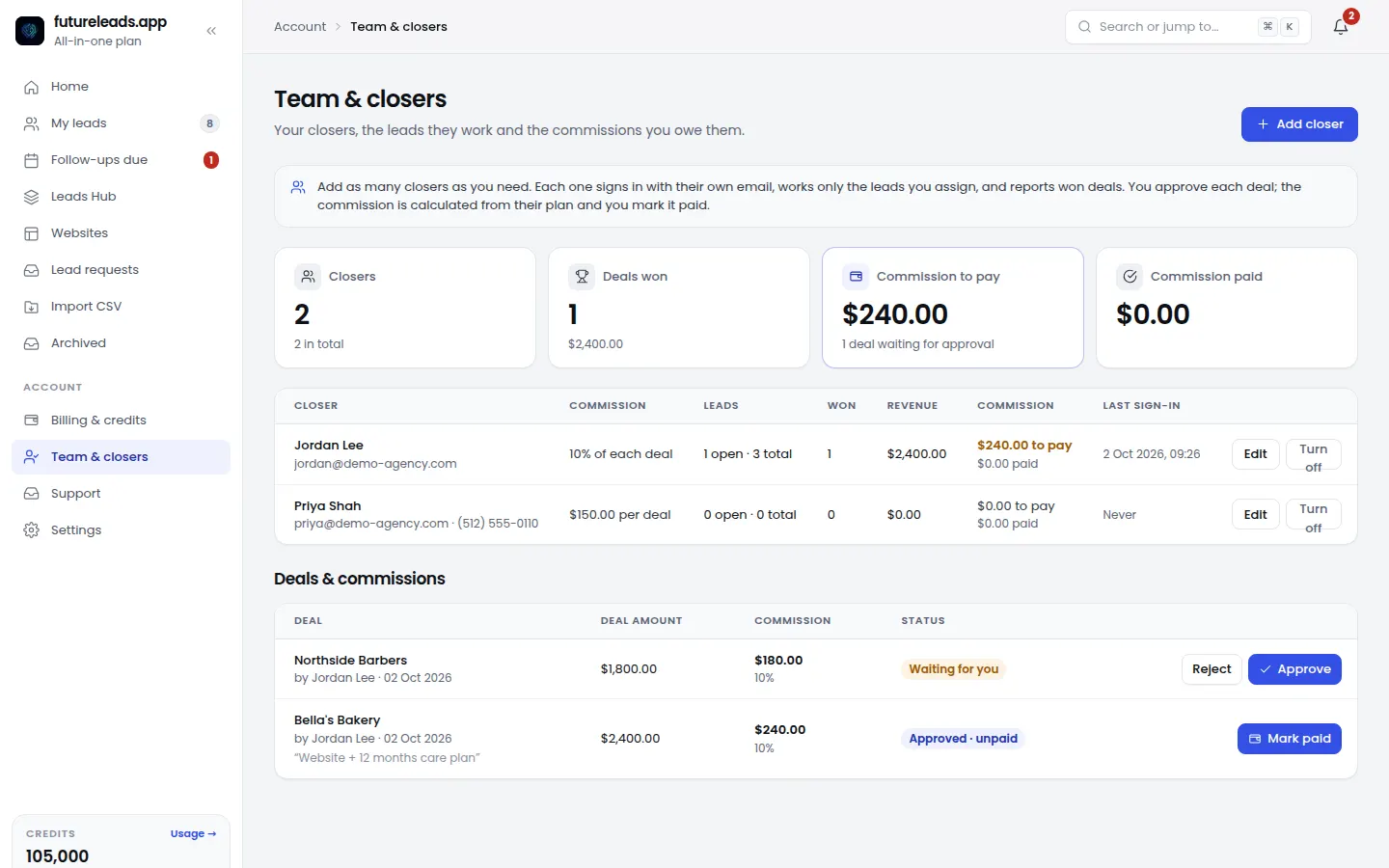
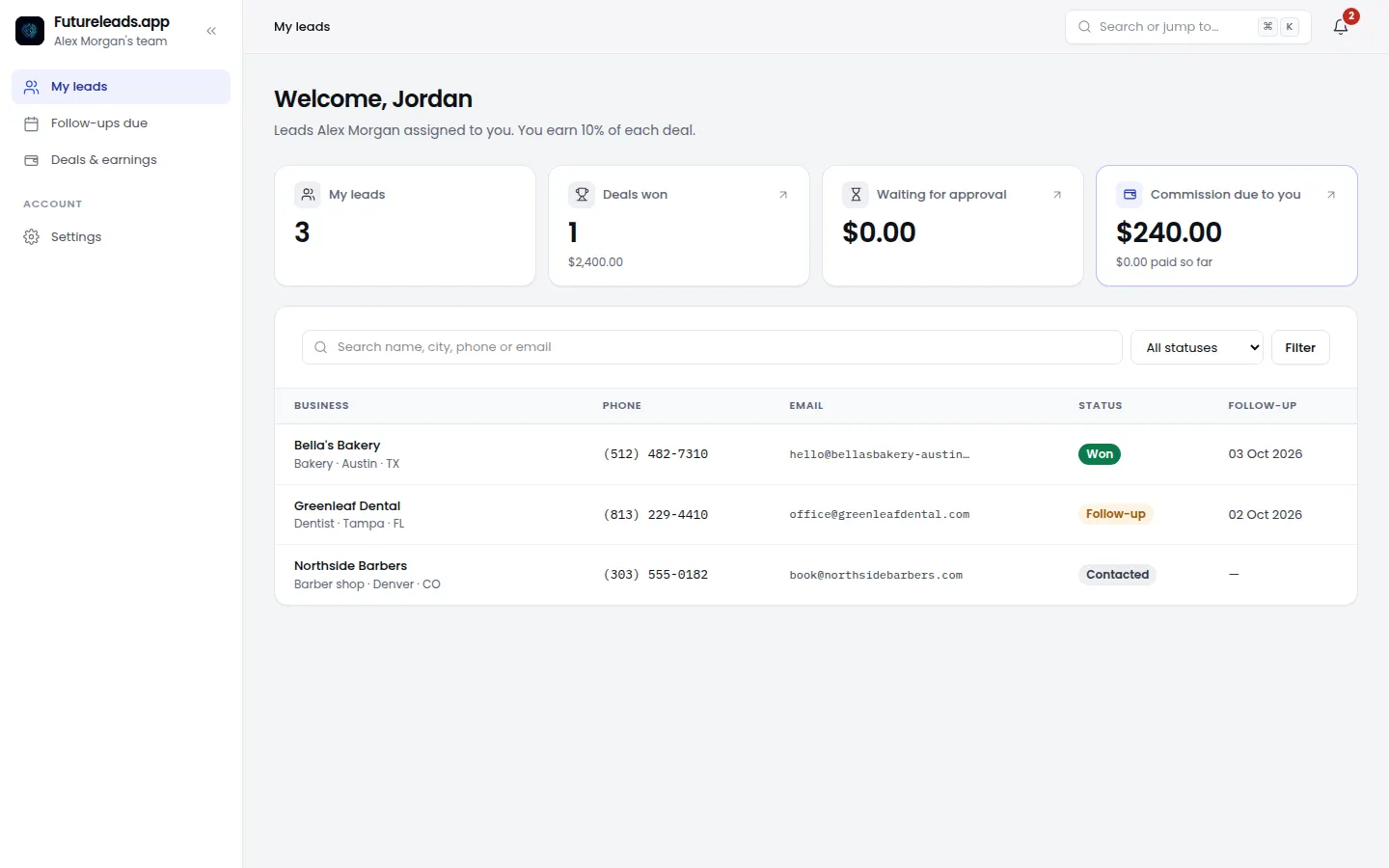
The order matters. Hiring another designer before you have consistent lead flow just adds salary costs. Hire a closer first: someone who works your existing pipeline, makes the calls and closes deals while you build. Read our full guide on how to hire a closer for your web design agency.
Futureleads.app supports this directly: add team members, assign leads to them, and see their calls, notes and deals in one dashboard. Your closer works the Leads Hub, you keep building, and nothing lives only in someone's head.
A simple scaling roadmap: your first 90 days
- Weeks 1–2: pick a niche and city, build a list of 100+ businesses that need a website.
- Weeks 3–4: warm up your email domain, set up your CRM and templates, start outreach at a fixed weekly quota.
- Months 2–3: send AI previews to every warm lead, close your first productised deals, attach maintenance to every contract.
- End of month 3: review your numbers (leads added, calls made, replies, deals), then decide whether to hire a closer or expand to a second city.
If you're earlier in the journey — no clients yet — start with how to get your first web design client and how to start a website design business from home. Scaling comes after proof.
Ready to build your pipeline? Start a free Futureleads.app account — no card required — and find local businesses without websites in your niche and city today. Paid packages start from $9.99/month when you're ready to scale up.
Find businesses that need a website — freeor claim up to 3,000 FREE credits with a paid planFrequently asked questions
When should I start scaling my web design business? Once you've closed a handful of clients with a repeatable process. If every project is still improvised and you're not sure where your last client came from, fix that first — scaling amplifies whatever system you already have.
How do I get more web design clients without spending on ads? Prospecting local businesses directly: build a list of businesses with no website or a bad one, then run consistent cold email and cold calling. It costs time, not money, and it's the most reliable channel for local web design work.
Should I hire designers or salespeople first? Sales first. A closer working your existing pipeline generates revenue immediately, while another designer only adds capacity you may not need. Hire builders once sales consistently outpace your production time.
How many leads do I need to scale consistently? Work backwards from your close rate: if you close roughly one in ten leads you contact, and you want two new clients a month, you need around twenty fresh conversations monthly. Set a weekly prospecting quota that makes that math work.
Is recurring maintenance income worth it for a small agency? Yes — it's the difference between starting from zero each month and having a predictable base. Every website you build is a natural maintenance client, and it also keeps you first in line for redesigns and referrals.
Pick a package: every feature is included in each, paid plans add FREE bonus credits every month, or start free with no card.
Basic
$9.99/month
11,500 credits a month
+ 1,000 FREE credits
- About 261 done-for-you leads
- or 88 AI website previews
- All features included
Pro
$39/month
50,000 credits a month
+ 1,500 FREE credits
- About 1,136 done-for-you leads
- or 384 AI website previews
- All features included
Premium
$79/month
105,000 credits a month
+ 3,000 FREE credits
- About 2,386 done-for-you leads
- or 807 AI website previews
- All features included