Web design agency growth strategies don't have to be complicated. In practice, most growing agencies rely on a handful of repeatable systems: a steady local lead pipeline, fast outreach, a simple sales process, and recurring revenue that smooths out slow months.
This guide walks you through the seven strategies that matter most, in the order you should implement them. Every section includes concrete steps, scripts or templates you can copy today — no theory, no fluff.
1. Pick one niche and one city to start
The fastest-growing web design agencies aren't the ones that say "we build websites for everyone." They're the ones that dominate a specific niche in a specific area — say, dentists in a mid-size city, or plumbers across three nearby towns.
Why? Because focus compounds. When you've built a homepage preview for one dentist, you can adapt it for the next in minutes. When you've written one cold email for roofers, you know exactly which subject lines get replies. Your pitch gets sharper, your previews get faster, and your results get easier to demonstrate.
- List 5–10 local niches where businesses clearly make money from their website (restaurants, dentists, gyms, contractors, salons, lawyers).
- Check which niches are underserved: search the niche plus your city and note how many businesses have no website or a badly outdated one.
- Pick the niche where you found the most problems — that's where demand meets opportunity.
- Commit to that niche for 90 days before you even think about expanding.
How to choose your niche and city:
2. Build a lead pipeline instead of waiting for referrals
Referrals are great, but you can't control them. Growth strategies that actually scale are built on a pipeline you own: a list of local businesses that need what you sell, with contact details and a reason to reach out.
The most direct version of this pipeline is businesses with no website or a broken one. They have an obvious, urgent problem — customers can't find them or can't use their site on a phone. Our guide on finding local businesses without websites breaks down how to build that list manually; the guide on finding businesses with bad websites covers the second-biggest opportunity: sites that exist but embarrass their owners.
This is exactly what Futureleads.app automates: search any niche and city and get a list of local businesses with no website, a slow site, or a not-mobile-friendly one — complete with phone numbers, emails and the specific problems found, ready in your Leads Hub. You can start free (no card) with a live lead search every day, which is enough to test this strategy before you spend anything.
Want to see your own pipeline in the next five minutes? Start a free Futureleads.app account (no card required) and run a live search for your niche and city right now.
Find businesses that need a website — freeor claim up to 3,000 FREE credits with a paid planOnce your pipeline exists, the rest of your growth comes down to how fast and how well you work it. That's what the next strategies cover.
3. Lead with proof, not with your pitch
Local business owners are pitched constantly — by marketers, directories, and every agency in town. The outreach that stands out doesn't describe what you could do. It shows it.
Instead of "I build websites, let's talk," send the prospect a homepage preview made for *their* business, with their name, their photos or color scheme, and a clear layout. Seeing their own brand on a modern homepage does the selling for you. Futureleads.app's AI website previews let you build one in minutes and send it as a link or QR code before the client has paid you anything.
- The prospect's business name and industry, not a generic template.
- A mobile-friendly layout — many owners will open it on their phone.
- One sentence on the problem you found ("your current site doesn't load on mobile").
- A single, low-friction call to action: "Want me to finish it?"
What a good preview-first pitch includes:
You can pair the preview with a short audit of what's wrong with their current site — our website audit checklist and the signs a business needs a new website give you plenty of talking points.
4. Run cold outreach like a system, not a mood
Every growing agency has a consistent outreach engine. Not perfection — consistency. You need two channels working in parallel: email and calling.
Email: short, personal, one ask
Cold email for web design works when it's about the prospect, not about you. Keep it under 100 words, mention the specific problem you found, and link to their preview. Our web design cold email template and the full cold email for web design services guide give you word-for-word starting points, and the cold email follow-up for web designers covers the emails that actually close deals — the follow-ups.
Send from your own Gmail or SMTP account so replies land in your real inbox and deliverability stays healthy. Futureleads.app's email campaigns run from your own accounts with automatic follow-ups, so sequence 1–3 goes out on autopilot while you focus on calls and builds.
Calling: five good calls beat fifty avoided ones
Calling feels scary until you have a script and a rhythm. A preview ready on your screen changes the whole call: "I actually built a homepage for you — want me to text you the link?" is a far better opener than any features list. Our cold calling script for web design clients and the voicemail script for cold calling give you exact words, and the dialer in Futureleads.app lets you call straight from the browser with call history and notes on every lead, so nothing gets lost.
5. Follow up until you get a clear answer
Most web designers give up after one email and one call. Most local business owners reply after touch three, four or five. That gap is where almost all your lost revenue lives — and closing it is one of the cheapest growth strategies available.
- Day 1: first email with the preview link or a QR code.
- Day 2: a short call. If no answer, leave a voicemail.
- Day 4: follow-up email — "Did you get a chance to look at the preview?"
- Day 7: second call, different time of day.
- Day 10: breakup email — "I'll stop reaching out — the preview stays live if you want it."
- Then move the lead to a nurture status and check back in 30–60 days.
A simple follow-up sequence that works:
The same discipline applies after you send a proposal — see how to follow up after sending a proposal. Track every lead's status in a simple CRM so follow-ups happen on schedule, not from memory. Futureleads.app includes lead statuses, notes and follow-up reminders, which is exactly enough structure for a small team.
6. Add recurring revenue before you scale anything
One-off website projects create feast-or-famine cycles. Recurring revenue — maintenance, hosting, care plans, or a website-as-a-service subscription — is what turns an agency into a stable business, and it's the single best foundation for growth.
- Care plans: monthly updates, backups, uptime checks and small edits. See our guide to website maintenance packages and how much to charge for website maintenance.
- Website as a service: no big upfront cost — the client pays a monthly fee and the site is included. Our website as a service pricing guide shows how to package it.
- Lead capture retainers: manage the booking or quote forms the site generates, so the client sees you as a growth partner, not a vendor.
Three ways to attach recurring revenue to every deal:
Make recurring revenue part of the pitch from day one, not an upsell after launch. Our deep dive on recurring revenue web design covers seven models you can mix and match. And once clients are paying monthly, branded invoices and a simple client portal keep the relationship smooth — Futureleads.app includes both on paid plans, so clients can log in, see their site, their form leads and their invoices in one place.
7. Build a repeatable sales process — then delegate it
You can't grow past your own calendar. The moment your sales process works — preview, outreach, follow-up, proposal, close — document it so someone else can run it. That's how solo freelancers become agencies.
- Where leads come from (your niche and city pipeline).
- The first-touch sequence: email script, call script, voicemail script.
- The preview step and how it's presented.
- The proposal template and pricing framework — see website pricing for clients.
- Objection handling: the five objections you hear most and your exact answers.
- Handoff to onboarding, so a signed deal moves smoothly into a build.
Your documented sales process should cover:
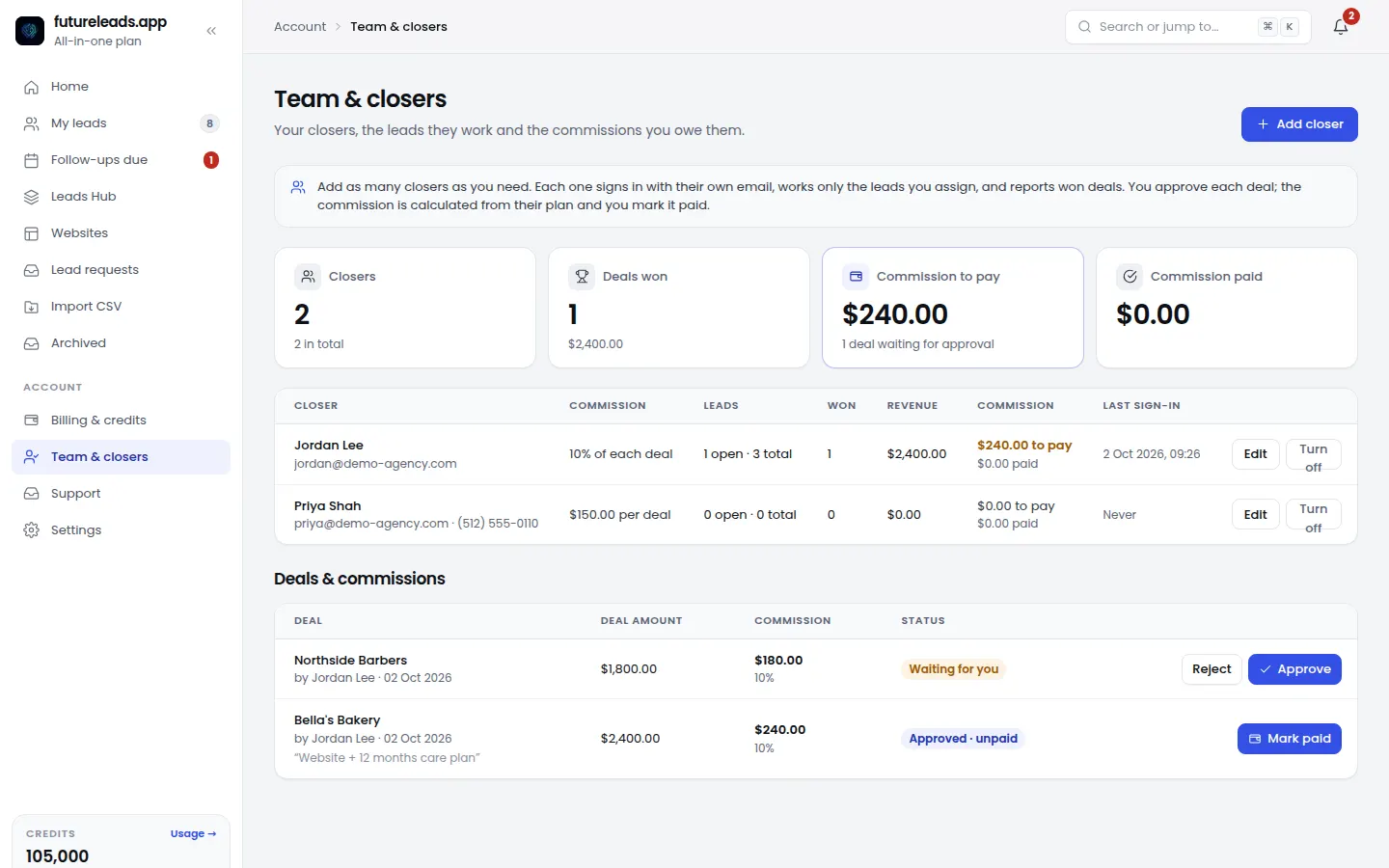
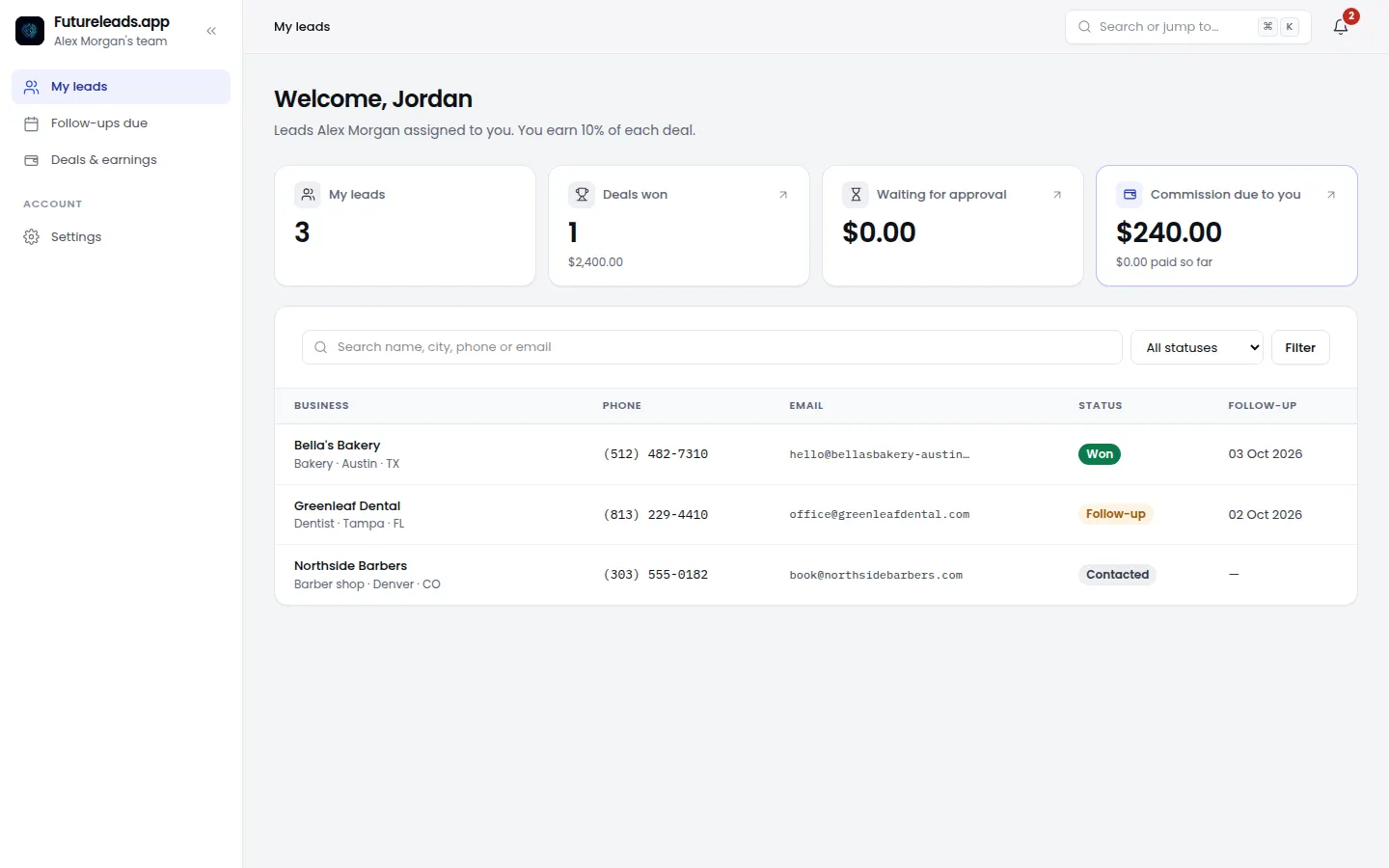
With that in place, you can add closers who work your pipeline while you build. Our guide on hiring a closer for your web design agency walks through the setup, and the team features in Futureleads.app — assign leads to closers, see their calls and deals — make it easy to supervise without micromanaging. For the bigger picture of scaling, read how to scale a web design business.
Your 30-day growth checklist
Here's everything above compressed into one month of focused work. Print it, tape it somewhere visible, and tick each item off.
- Pick your niche and city.
- Build a list of at least 100 local businesses with no website, a slow site or a non-mobile-friendly one.
- Write your first cold email and call script.
Week 1 — Foundation:
- Build AI homepage previews for your 20 best prospects.
- Send the first 20 preview-first emails.
- Log every lead and touchpoint in your CRM.
Week 2 — Proof:
- Send 10–15 outreach emails per day with automatic follow-ups running.
- Make 10 dials per day using your script.
- Book first calls; send proposals within 24 hours of each call.
Week 3 — Volume:
- Review what got replies: which subject lines, which previews, which times.
- Define your recurring revenue offer and attach it to every proposal.
- Document your process so it can be handed off — or expand to a second city.
Week 4 — Systemize:
Ready to run this checklist with a real pipeline behind it? Start your free Futureleads.app account — no card needed — and pull your first list of local businesses that need a website today.
Find businesses that need a website — freeor claim up to 3,000 FREE credits with a paid planFAQ
How do web design agencies get clients quickly? Build a pipeline of local businesses with no website or a bad one, then reach out with proof — like a homepage preview made just for them. Email plus calling, with consistent follow-ups, gets first meetings faster than waiting for referrals.
What's the best growth strategy for a small web design agency? Focusing on one niche in one city. It makes your outreach sharper, your previews faster to produce, and your results easier to prove to the next prospect.
How can I get recurring revenue as a web designer? Attach a monthly care plan, maintenance package or website-as-a-service subscription to every project you sell. Pitch it during the sale, not after launch.
Is cold calling still effective for web design agencies? Yes — especially when you call with something specific, like a preview of their new homepage. A script and a daily call habit matter more than being a natural on the phone.
When should I hire a salesperson for my agency? Once you have a documented, repeatable sales process that you can hand over, and a steady pipeline of leads for them to work. Hiring before the process exists just creates chaos.
Pick a package: every feature is included in each, paid plans add FREE bonus credits every month, or start free with no card.
Basic
$9.99/month
11,500 credits a month
+ 1,000 FREE credits
- About 261 done-for-you leads
- or 88 AI website previews
- All features included
Pro
$39/month
50,000 credits a month
+ 1,500 FREE credits
- About 1,136 done-for-you leads
- or 384 AI website previews
- All features included
Premium
$79/month
105,000 credits a month
+ 3,000 FREE credits
- About 2,386 done-for-you leads
- or 807 AI website previews
- All features included